
Location
123 Business Street, Suite 456
New York, NY 10001, USA
Contact us
Location


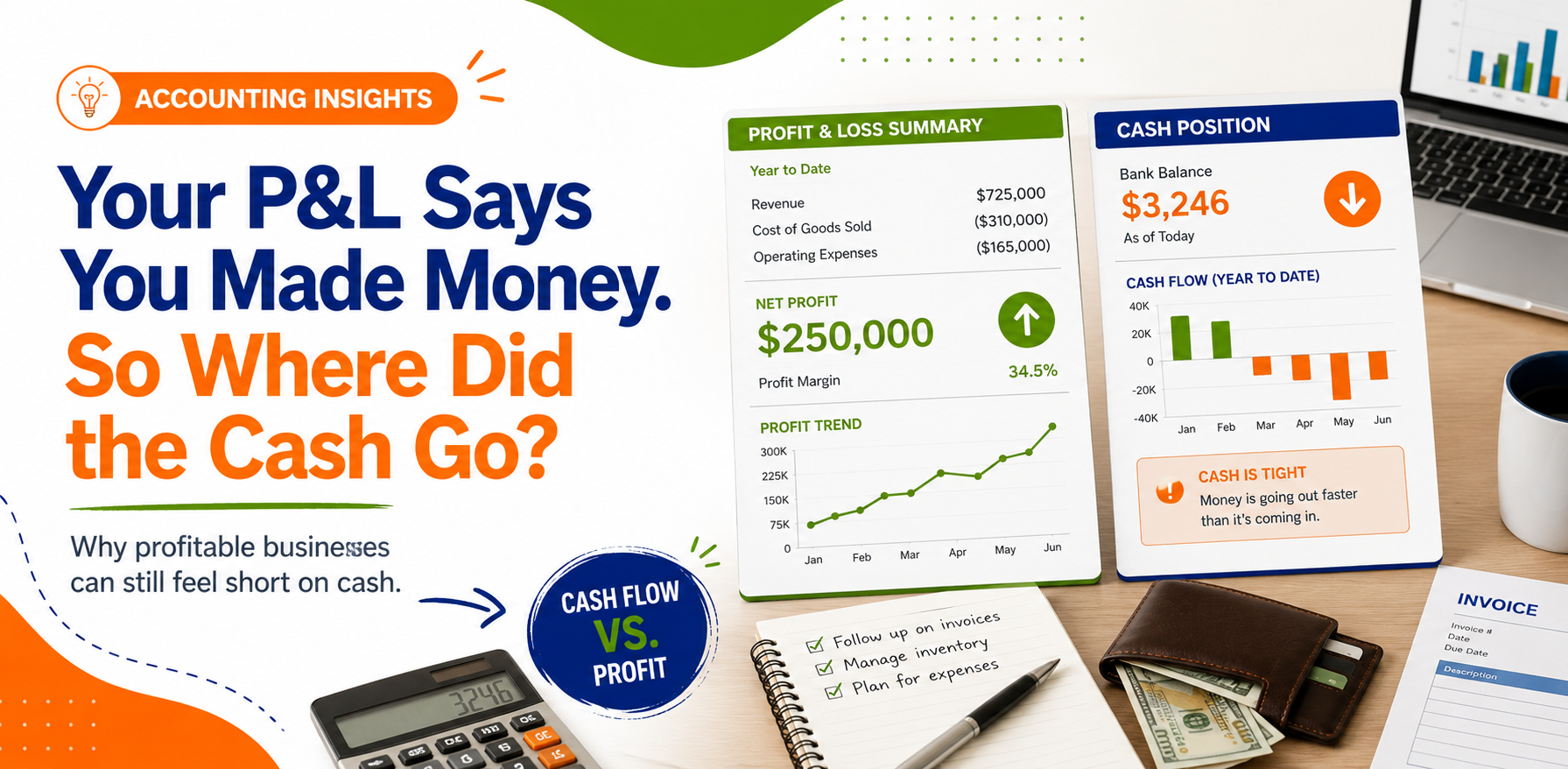
You pull up the profit and loss statement. Revenue looks good. Expenses seem under control. There is even a nice little number at the bottom labeled net profit.
Then you open the business bank account and think, okay... so where is it?
Welcome to one of the most frustrating parts of owning a growing business. Profit and cash are not the same thing. And if nobody has ever really explained that distinction, it can feel like your financial reports are telling you one story while your actual business is telling you another.
This is not an unusual problem. In the Federal Reserve's 2026 Small Business Credit Survey data for Colorado employer firms, 51% reported uneven cash flow as a financial challenge and 50% reported difficulty paying operating expenses such as payroll, rent, and inventory. So if your business looks profitable but cash still feels tighter than it should, you are asking exactly the right question.
The important part is figuring out why.
Profit tells you whether the business earned more than it spent over a particular period, based on the accounting method used to prepare the report. Cash flow tells you what actually happened to the cash.
Those two numbers can move in very different directions.
Your profit and loss statement answers the question, "Did we make money?" Your cash position answers a different question: "Can we pay the bills?" A healthy business needs to be able to answer both.
The U.S. Small Business Administration identifies the profit and loss statement, balance sheet, and cash flow information as different pieces of the financial picture. That distinction matters because looking only at profitability can leave you with an incomplete view of what is actually happening inside the business.
Imagine your business invoices a customer for $25,000 in August. Depending on your accounting method and how your financial reports are prepared, that revenue may appear on your P&L before all of the money reaches your bank account.
Congratulations, you made money.
Unfortunately, your landlord and employees are not particularly interested in your accounts receivable balance. They would prefer actual dollars.
That timing difference is one of the biggest reasons a business can appear profitable while still feeling cash strapped. The SBA explains that under accrual accounting, a sale is generally recorded when it is completed, while cash-basis accounting generally records it when payment is received. That difference can dramatically affect how an owner interprets financial reports.
Receivables are only one possible explanation, though. Cash can also be tied up in inventory, equipment purchases, debt payments, tax payments, owner distributions, prepaid expenses, or other balance-sheet activity that does not show up on your P&L the way you might expect.
That is why your P&L can be accurate and still not tell the whole story.
One of the first places to look is the money customers owe you.
If your sales are strong but customers are taking 45, 60, or 90 days to pay, your revenue may look great while your bank balance stays stubbornly low. A growing accounts receivable balance can create a strange situation where the business is technically doing well, but the cash has not caught up yet.
This is why it is important to review more than the total receivables balance. Look at the aging. An invoice that is five days old is very different from one that has been sitting unpaid for 95 days.
If overdue invoices are becoming normal, the accounting problem may actually be a collections problem.
The same issue can happen on the other side of the ledger.
You may have money in the bank today, but some of that money may already be spoken for. Vendor bills, rent, insurance, software, taxes, payroll, and other obligations may be sitting just around the corner.
That is one reason looking at your bank balance by itself can create a false sense of security. The money may technically be there, but it may not truly be available.
A clearer picture comes from looking at cash on hand alongside upcoming obligations.
Payroll has a remarkable ability to turn "we have plenty of cash" into "where did all the money go?" very quickly.
For businesses with employees, payroll is usually predictable, which is actually good news. Predictable expenses can be planned for.
Look at your payroll calendar through the end of the year. Are there any months with three payroll cycles if you pay biweekly? Are bonuses coming up? Commissions? Benefit costs? Payroll taxes? New hires?
These are not surprises if you are looking ahead.
The goal is not to wait until payroll week to figure out whether payroll fits. The goal is to see it coming before it becomes stressful.
Your P&L and your bank account may treat a loan payment very differently.
Interest is generally recorded as an expense, while principal repayment usually reduces a liability on the balance sheet rather than showing up as a normal operating expense on the P&L.
But both pieces still leave the checking account.
That means a business can report a reasonable profit while still experiencing significant cash outflow because of debt service.
If your company has equipment loans, lines of credit, vehicle loans, or other debt, those payments need to be part of your cash planning even if they are not obvious on the income statement.
Inventory can quietly soak up a lot of cash.
You spend the money today, but the financial impact does not always appear on your P&L at the same time. The same issue can happen when the business buys equipment or other long-term assets.
That new vehicle, computer system, piece of machinery, or office buildout may be a smart investment. It can also take a significant bite out of the bank account.
The key is understanding the difference between a business that is losing money and a profitable business that is investing cash. Those are two very different situations, and they call for very different decisions.
This one often gets overlooked.
Money taken out by an owner does not always appear as a normal business expense on the P&L. So the business may produce a healthy accounting profit while a significant amount of cash is leaving the company through owner distributions or draws.
That does not automatically mean the owner is taking too much money out.
It means those distributions need to be part of the cash conversation.
The P&L alone will not tell you whether the business is retaining enough cash to operate comfortably.
One of the most useful things a business owner can do is stop treating accounting as something that only explains what already happened.
A simple 90-day cash forecast can change the conversation.
Start with the cash you have now. Estimate what is realistically expected to come in. Then map what needs to go out, including payroll, rent, vendor payments, debt, taxes, insurance, inventory, major purchases, and owner distributions.
You do not need a 47-tab spreadsheet with enough formulas to launch a satellite.
You need a forecast you will actually look at.
The SBA continues to emphasize cash-flow forecasting and understanding financial statements as tools for better business decision-making. That is because financial information becomes much more valuable when it helps you make decisions before the money is already gone.
At minimum, most business owners should understand three views of the company.
The profit and loss statement tells you how the business performed over a period of time. The balance sheet shows what the business owns, what it owes, and the owner's equity at a specific point in time. Cash-flow information helps explain how money is moving through the business.
For many growing businesses, we would add one more report to that list: accounts receivable aging.
Because "we made the sale" and "we got paid" are two completely different sentences.
The SBA highlights these core financial statements as tools for understanding profitability, financial position, available cash, and business decision-making. Together, they provide a much more complete picture than any single report on its own.
Then that is the first problem to solve.
A beautiful dashboard built on incomplete bookkeeping is still incomplete bookkeeping.
Bank and credit card accounts need to be reconciled. Transactions need to be categorized correctly. Loans need to be recorded properly. Payroll needs to tie out. Receivables and payables need to reflect reality.
The IRS notes that good business records help owners monitor the progress of the business, prepare financial statements, track income and deductible expenses, prepare tax returns, and support what is reported.
In other words, bookkeeping is not just something you clean up for tax season.
It is the foundation underneath the financial decisions you are making all year long.
No.
Sometimes cash is tight because the company is growing. Sometimes customers are paying slowly. Sometimes the business made a major investment. Sometimes inventory increased. Sometimes debt payments are consuming cash. Sometimes owner distributions are higher than the company can comfortably support.
And sometimes the answer is less comfortable: margins are too thin, expenses have crept up, pricing is wrong, or the business simply is not producing enough profit.
The numbers are not there to judge you. They are there to help you identify which problem you actually have.
That distinction matters because every one of those situations requires a different response.
Cutting expenses will not fix slow receivables. Borrowing more money will not fix bad margins. Increasing sales will not automatically fix a business that loses money on every sale.
And staring at the bank balance definitely will not fix any of them.
Colorado business owners are dealing with many of the same pressures showing up nationally, including higher costs and uneven cash flow.
The Federal Reserve's 2026 Colorado data found that 55% of Colorado employer firms surveyed reported increased costs of goods, services, or wages as a financial challenge. Another 51% cited uneven cash flow, and 50% reported difficulty paying operating expenses.
That makes knowing your numbers more than an accounting exercise.
It is a business management skill.
If costs are moving, cash is uneven, and the business is making hiring, pricing, or growth decisions, financial information cannot be something you review once a year when the tax return is due.
You need it while there is still time to do something with it.
Your P&L measures profitability, while your bank balance reflects cash currently available. The difference can come from unpaid customer invoices, inventory purchases, loan principal payments, equipment purchases, owner distributions, taxes, and other cash activity that is not reflected on the P&L in the same way.
You need both. A business ultimately needs to generate profit, but it also needs enough cash available to meet obligations as they come due. A profitable company can still experience serious problems if the timing of cash coming in does not match the timing of cash going out.
For many small businesses, a monthly review is a good baseline. Businesses with tight cash, rapid growth, seasonal revenue, large payrolls, or significant receivables may benefit from reviewing cash weekly and maintaining a rolling cash forecast.
There is no single answer because the right fix depends on the cause. Faster collections, better payment terms, pricing changes, expense management, inventory control, debt restructuring, and better forecasting can all affect cash flow. The first step is identifying where the cash is actually going.
Yes. The P&L tells you about profitability. Cash-flow information helps explain changes in available cash. Looking at both can help you understand why a profitable month may not have produced the bank balance you expected.
There is a point in almost every growing business when bookkeeping has to become more than recording transactions.
The numbers need to start helping you run the company.
Why is cash tight? Can we afford another employee? Can we make that purchase? Are customers paying us quickly enough? Are our margins improving? How much cash should we keep in reserve? What happens if sales slow down for two months?
Those are not tax-return questions.
Those are business-owner questions.
And you should not have to wait until the end of the year to get answers.
If your P&L says everything is going great but your bank account keeps raising its hand with objections, it is worth looking deeper.
That is where good accounting becomes useful.
Not because the reports are impressive, but because they help you see what is happening, understand why it is happening, and decide what to do next.
That is the kind of accounting relationship Savvion believes small business owners deserve.




.svg)