

Location
123 Business Street, Suite 456
New York, NY 10001, USA
Contact us
Location


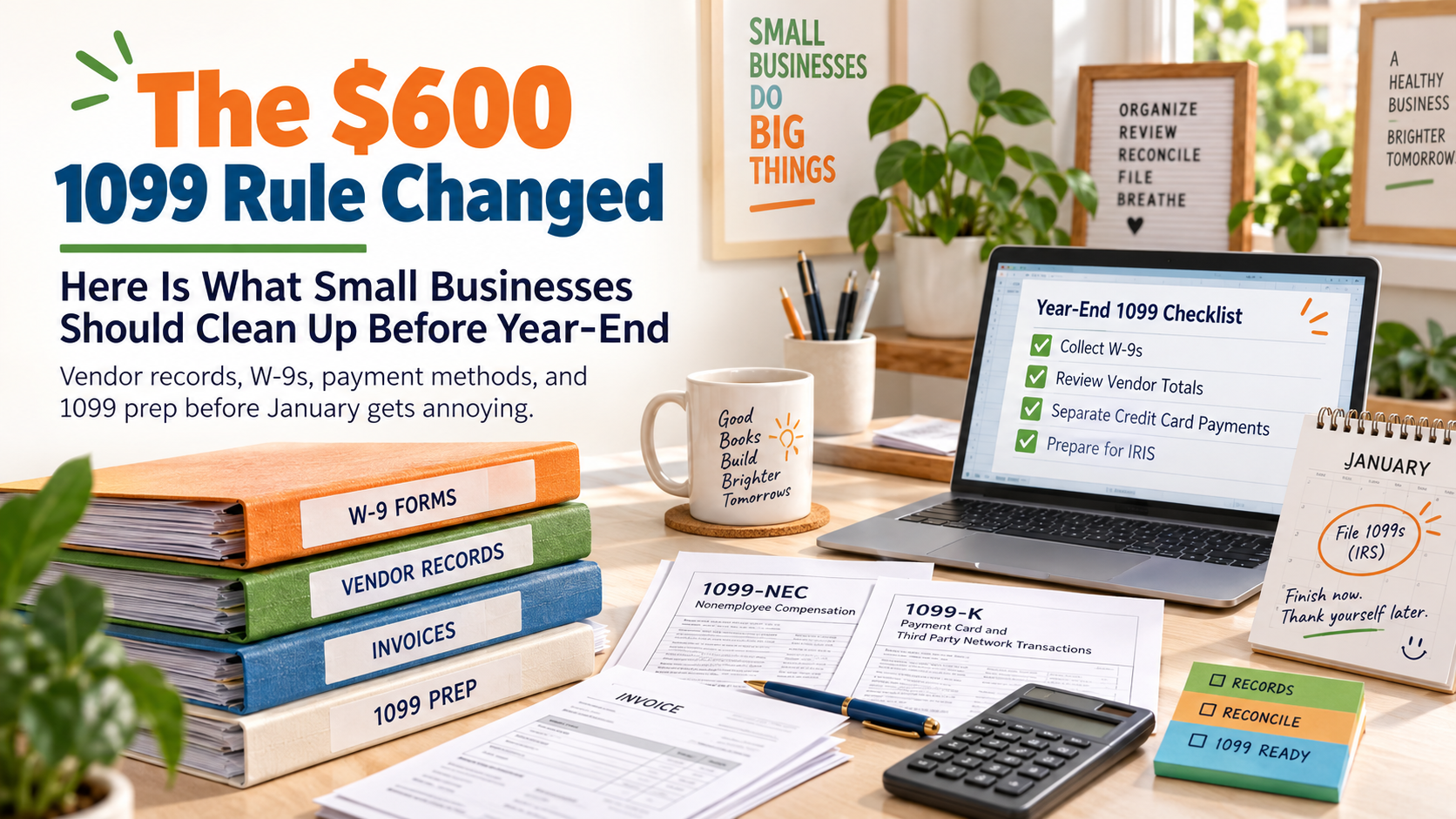
January has a funny way of turning perfectly reasonable business owners into detectives.
Who was this $1,850 payment to?
Did we ever get a W-9 from that contractor?
Was this vendor paid by check or credit card?
Is "Bob's Marketing" a person, an LLC, an S corporation, or just what Bob typed into the invoice template?
And why are there three vendors in QuickBooks that appear to be the exact same person?
This is why we are talking about 1099s in September.
Not because we are trying to rush the holidays.
Because year-end reporting gets dramatically easier when the bookkeeping underneath it is already clean.
There is also a significant change for 2026 that small business owners should know about. For many common nonemployee compensation payments, the federal Form 1099-NEC reporting threshold increased from $600 to $2,000.
That means fewer 1099s may need to be issued next January.
It does not mean you can stop paying attention to your vendors.
For payments made before 2026, businesses generally had to issue Form 1099-NEC when reportable payments to a nonemployee reached $600 during the calendar year.
For payments made in 2026, that threshold increased to $2,000.
The IRS now states that businesses generally must report nonemployee compensation when payments for services reach or exceed the applicable reporting threshold, and specifically notes that the threshold increased from $600 to $2,000 for payments made in 2026. Beginning after 2026, that amount will be adjusted for inflation.
So imagine you hire a freelance designer and pay her $1,500 during 2026.
Assuming there are no unusual circumstances, that payment would generally fall below the new Form 1099-NEC reporting threshold.
If you pay the same designer $2,500, the payment may be reportable.
That seems straightforward.
Naturally, accounting has a few more questions for us.
No.
Please do not make January the month you start chasing people you hired the previous February.
The cleanest practice is still to collect a completed Form W-9 when the vendor relationship begins.
The IRS specifically recommends obtaining Form W-9 when you determine that someone you are paying is an independent contractor. The W-9 gives you the payee's legal name, taxpayer identification number, and tax classification. The IRS also recommends keeping the form in your records for four years.
There is a practical reason for doing this up front.
You may think a contractor will only do one $500 project.
Then you hire them again.
And again.
Suddenly it is December and you have paid them $4,800.
Getting a W-9 from someone while they are actively doing business with you is usually pretty simple.
Tracking them down eleven months later because you need their taxpayer identification number by Friday is considerably less fun.
Missing or incorrect taxpayer identification information can also create backup withholding obligations. IRS guidance states that certain reportable payments may be subject to 24 percent backup withholding when a payee fails to provide a taxpayer identification number or the IRS advises that the number is incorrect.
So no, the higher reporting threshold did not make vendor setup irrelevant.
It made good vendor setup just as useful as it was before.
Not necessarily.
The dollar amount is only one part of the question.
Generally, Form 1099-NEC is used when a business pays someone who is not its employee for services performed in the course of the business and the payments meet the reporting threshold. But whether a particular vendor requires a form can also depend on the vendor's tax classification, the type of payment, and how the payment was made.
For example, many payments to corporations are treated differently for information-reporting purposes, while certain payments to attorneys can remain reportable even when the law firm is incorporated.
This is another reason the W-9 matters.
"ABC Consulting LLC" does not tell you enough.
An LLC can be taxed in several different ways. The completed W-9 tells you how that vendor is classified for federal tax purposes.
Your accounting system should reflect that information instead of asking someone to make an educated guess in January.
This is an easy place to accidentally double-report income.
Payments made with payment cards and certain third-party network transactions are generally reported by the payment settlement entity on Form 1099-K rather than by the business on Form 1099-NEC or Form 1099-MISC. IRS instructions specifically state that those payments are not subject to Form 1099-NEC or 1099-MISC reporting by the business when they fall under the Form 1099-K reporting rules.
That means your accounting records need to distinguish how a vendor was paid.
Suppose you paid a contractor $5,000 during the year.
If $2,000 was paid by check and $3,000 was paid by credit card, you cannot necessarily look at the vendor's $5,000 total in QuickBooks and automatically put $5,000 on a 1099-NEC.
The payment method matters.
This is one reason we like reviewing 1099 vendor reports before year-end instead of blindly accepting whatever total the software produces in January.
Accounting software is very good at math.
It is less good at understanding what happened if nobody told it.
Yes, although that is a separate reporting rule.
The federal reporting threshold for third-party settlement organizations, such as certain payment platforms, reverted to the prior standard. Those organizations generally are not required to issue Form 1099-K unless payments to a payee exceed $20,000 and involve more than 200 transactions.
The Taxpayer Advocate Service notes that this change affects reporting requirements, not whether the underlying income is taxable. Business income does not suddenly become nontaxable simply because no Form 1099 was issued.
That distinction is important on both sides of the transaction.
A form tells the IRS about income.
The form does not create the income.
Your books should still reflect the actual business activity whether a 1099 exists or not.
Absolutely not.
This one is worth saying clearly because two very different issues sometimes get mixed together.
The 1099 reporting threshold determines whether certain payments need to be reported on an information return.
It does not determine whether someone is an employee or an independent contractor.
You do not turn an employee into a contractor by paying them less than $2,000.
You do not turn a contractor into an employee because they earned $25,000.
Worker classification depends on the actual working relationship.
For federal purposes, the IRS evaluates factors involving behavioral control, financial control, and the relationship between the parties. The label in the contract is not the deciding factor.
That matters because businesses sometimes treat the 1099 itself as proof that someone is an independent contractor.
It is not.
Form 1099 reports a payment.
Worker classification determines whether the payment belonged on a 1099 in the first place.
Those are two very different conversations.
Because September gives you something January does not.
Time.
By this point in the year, you already have enough transaction history to see which vendors are likely to approach or exceed the $2,000 reporting threshold.
You can identify missing W-9s while those vendors are still working with you.
You can merge duplicate vendor records.
You can correct vendor tax classifications.
You can separate check, ACH, and direct payments from credit card transactions.
You can make sure contractor expenses have actually been coded to the right accounts.
You can review whether someone being treated as a contractor is truly functioning as one.
And you can do all of that without a January 31 deadline hanging over your head.
The IRS also emphasizes that good business records help owners prepare financial statements, track income and expenses, prepare tax returns, and support items reported on those returns. Supporting records such as invoices, receipts, payment records, and canceled checks are part of that accounting trail.
This is why 1099 cleanup is not really just a tax project.
It is an accounting project.
The tax form is simply where messy accounting eventually becomes visible.
If your company or accounting provider electronically files information returns directly with the IRS, there is another change coming for the 2027 filing season.
The IRS is retiring its Filing Information Returns Electronically system, better known as FIRE.
On August 24, 2026, the IRS issued a reminder that current FIRE users need to transition to the Information Returns Intake System, or IRIS, for tax year 2026 information returns filed during the 2027 filing season.
The IRS says IRIS will become the only electronic filing system for these information returns after January 1, 2027.
For many business owners, your accountant, bookkeeper, payroll provider, or filing service will handle this behind the scenes.
That is perfectly fine.
You should still know who is responsible.
"Someone takes care of the 1099s" is not quite the same thing as knowing exactly who is taking care of the 1099s.
If your company files its own forms, now is the time to make sure your IRIS access is ready rather than discovering the system change during filing season.
Businesses filing a combined total of 10 or more information returns are generally required to file electronically.
Form 1099-NEC is generally due to both the IRS and the recipient by January 31.
Because January 31, 2027 falls on a Sunday, the IRS weekend rule moves the filing deadline to the next business day, Monday, February 1, 2027. IRS instructions provide that when an information-return deadline falls on a Saturday, Sunday, or applicable legal holiday, the due date moves to the next business day.
February sounds comfortably far away right now.
It will not feel that way in January.
Especially if you have 14 missing W-9s.
A simple vendor review now can save a surprising amount of frustration later.
Before year-end, pull your vendor list and identify anyone who has been paid for services during 2026. Check year-to-date payments, look for vendors approaching the $2,000 threshold, confirm that you have completed W-9s, review tax classifications, and look for duplicate vendor profiles. Separate payments made directly by check or ACH from payments processed by credit card or applicable third-party networks. Then make sure someone has been clearly assigned responsibility for preparing and filing the forms.
If a contractor relationship looks suspiciously like employment, deal with that question separately. Do not let the accounting system make a worker-classification decision for you.
And if your business electronically files its own information returns, make sure the move to IRIS is already on your radar.
That is really the whole goal.
Not to turn September into January.
Just to make January considerably less annoying.
For payments made in 2026, the general reporting threshold for qualifying nonemployee compensation increased from $600 to $2,000. The threshold is scheduled to be adjusted for inflation after 2026.
Generally, a $1,500 payment would fall below the new $2,000 reporting threshold for Form 1099-NEC, assuming no special reporting or backup-withholding rule applies.
Yes. Collecting the W-9 when the relationship begins gives you the vendor's correct legal name, taxpayer identification number, and tax classification if the vendor later crosses the reporting threshold. The IRS recommends keeping contractor W-9s in your files for four years.
Generally, payments reportable through the payment-card and third-party network rules are reported by the payment settlement entity on Form 1099-K rather than by the business on Form 1099-NEC. Businesses should review payment methods carefully to avoid duplicate reporting.
For third-party settlement organizations, the reporting threshold generally reverted to more than $20,000 and more than 200 transactions. That reporting threshold does not determine whether the underlying business income is taxable.
No. Worker classification depends on the facts of the working relationship, not the amount paid or whether a Form 1099 is required. The IRS evaluates behavioral control, financial control, and the relationship between the parties.
IRIS is the IRS Information Returns Intake System. The IRS is retiring the FIRE filing system, and IRIS will be the electronic filing platform for tax year 2026 information returns filed during the 2027 filing season.
Nobody has ever called us in January and said, "You know what I really wish we had done? Made our 1099 process more chaotic."
The problems are usually incredibly ordinary.
A W-9 was never collected.
The contractor moved.
Two vendor records were created.
A legal name does not match the bookkeeping system.
Credit card payments were mixed together with checks.
Nobody remembers who was supposed to file the forms.
None of these problems is especially dramatic in September.
That is exactly why September is the right time to fix them.
The new $2,000 reporting threshold may mean fewer Forms 1099-NEC for some businesses this year, but it does not change the value of clean vendor records, accurate bookkeeping, good documentation, and knowing exactly who you paid and why.
Good accounting makes tax season easier.
It also makes everything between tax seasons easier.
Your books should be able to tell you what happened in your business without requiring an archaeological dig every January.
That is the goal.
And around here, a boring year-end close is something worth celebrating.




.svg)