

Location
123 Business Street, Suite 456
New York, NY 10001, USA
Contact us
Location


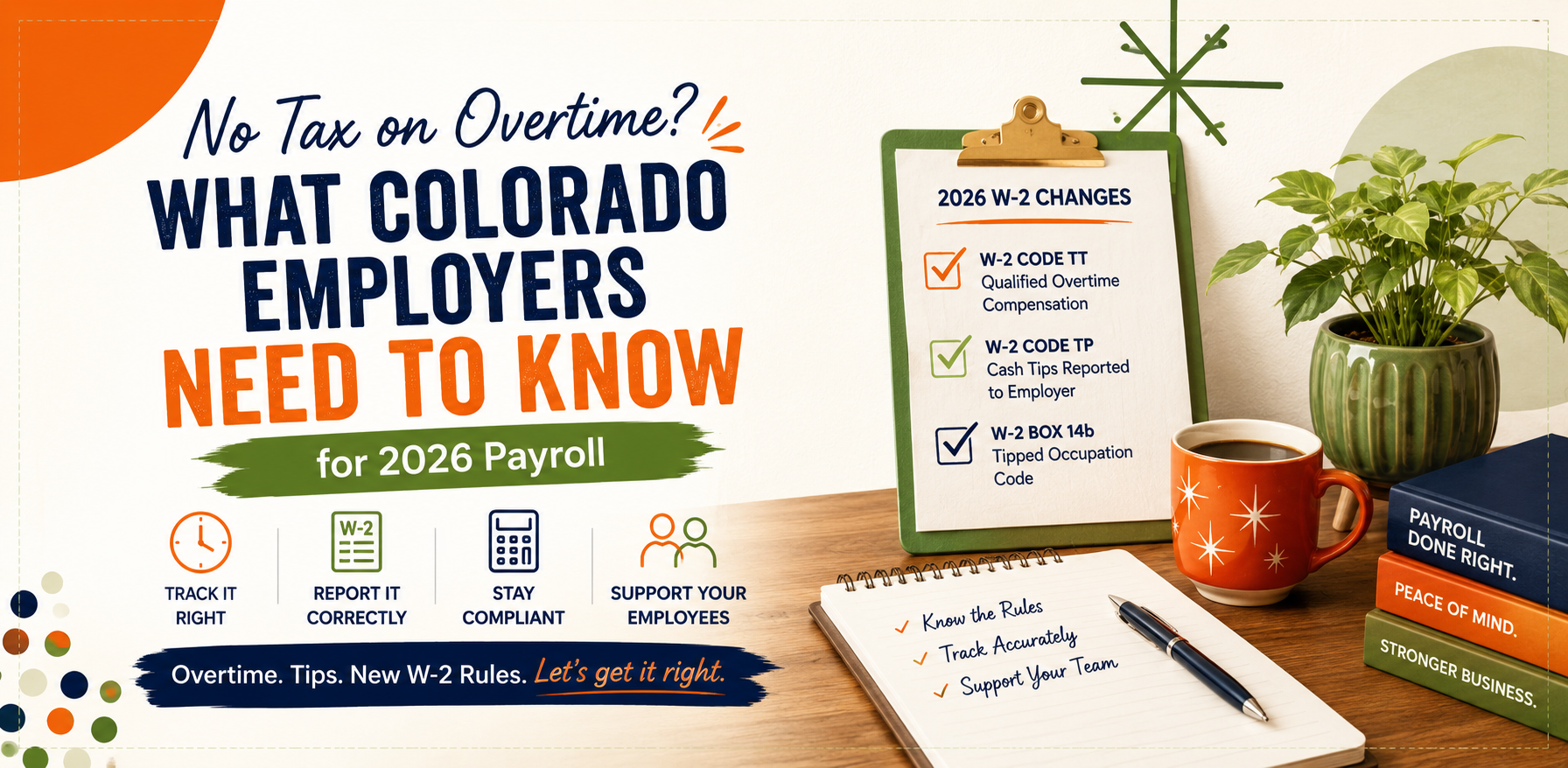
"No tax on overtime" sounds pretty simple.
Employee works overtime. Employee does not pay tax on it. Done.
Except, of course, payroll rarely gives us anything quite that easy.
The federal tax law changes that created new deductions for qualified overtime and certain tips are now showing up in the actual mechanics of payroll. And 2026 is especially important because this is the first year employers are required to separately report qualified overtime compensation on employees' W-2s.
If you have employees who work overtime, and especially if you are a Colorado employer, this is something worth looking at now rather than discovering during year-end payroll processing.
There is also one major misconception worth clearing up right away. "No tax on overtime" does not mean overtime suddenly becomes tax-free wages. The new provision is primarily an individual federal income tax deduction for qualifying employees. Overtime compensation generally remains subject to federal income tax withholding, Social Security tax, and Medicare tax. Employees may be able to adjust their federal withholding by submitting an updated Form W-4, but employers do not simply stop taxing overtime when it is paid.
That distinction matters. A lot.
For tax years 2025 through 2028, eligible individuals can deduct certain qualified overtime compensation on their federal income tax return. The maximum deduction is generally $12,500 for an individual or $25,000 for married taxpayers filing jointly, subject to income-based phaseouts.
The part employers need to pay closest attention to is the reporting requirement.
For 2025, the IRS provided transition relief and did not require employers to separately report qualified overtime compensation on Form W-2. That changes for 2026.
Beginning with tax year 2026, employers must separately report qualified overtime compensation. The 2026 Form W-2 includes a new Box 12 code, TT, specifically for that purpose.
So if your payroll system has traditionally tracked nothing more than "regular hours" and "overtime hours," this is a good time to confirm that it can also identify the portion of overtime that actually qualifies for federal reporting.
Because those are not necessarily the same number.
This is where things start to get a little more interesting for Colorado employers.
The federal deduction applies to overtime compensation required under Section 7 of the Fair Labor Standards Act, or FLSA. Under the FLSA, covered, nonexempt employees generally become eligible for overtime after working more than 40 hours in a workweek. The qualified amount is generally the portion paid above the employee's regular rate.
For example, if an employee earns $20 per hour and receives $30 per hour for federally required time-and-a-half overtime, the entire $30 is not considered qualified overtime compensation for purposes of the deduction. Generally, it is the additional $10, the "half" portion of time and one-half, that qualifies.
That alone may surprise some employees.
It may surprise a few employers too.
But Colorado adds another layer.
Colorado requires overtime in more situations than federal law.
Under Colorado's 2026 COMPS rules, covered employees generally must receive time and one-half after more than 40 hours in a workweek, more than 12 hours in a workday, or more than 12 consecutive hours, whichever calculation produces the greater amount of pay.
That means a Colorado employee can legitimately earn overtime without ever working more than 40 hours in the week. Imagine an employee works 13 hours on Monday but only 37 hours during the entire week. Colorado law may require an hour of overtime because the employee exceeded 12 hours in a workday.
Federal law, however, generally would not require overtime based solely on that 13-hour day because the employee did not exceed 40 hours for the week. And that distinction matters for the federal tax deduction. The IRS defines qualified overtime as overtime compensation required under the FLSA. Overtime paid because of another law or arrangement does not automatically qualify if it is not required under the FLSA.
So some overtime wages that are absolutely required under Colorado law may not be qualified overtime compensation for purposes of the federal deduction.
Welcome to payroll.
This may be the most important takeaway in the entire article.
Overtime compensation is still generally wages.
It remains subject to Social Security and Medicare taxes, including both the employee and employer portions. It also generally remains subject to federal income tax withholding when payroll is processed. The deduction happens on the employee's individual tax return.
Employees who expect to qualify may submit an updated Form W-4 to account for the deduction and potentially reduce their federal income tax withholding during the year. If an employee gives you a properly completed updated W-4, the employer should process it using the normal federal withholding procedures.
What the employer should not do is independently decide, "Overtime is tax-free now," and turn withholding off.
That would create an entirely different payroll problem.
And nobody needs another payroll problem.
The 2026 Form W-2 has a new reporting code specifically for qualified overtime. Code TT in Box 12 reports the employee's total qualified overtime compensation. Again, this is not necessarily the employee's total overtime wages.
For a standard time-and-one-half payment, only the premium portion above the employee's regular rate may qualify when that overtime is required under the FLSA. For employers with a lot of overtime activity, this makes payroll configuration especially important.
You do not want someone manually reconstructing 52 weeks of employee overtime next January trying to figure out which amounts belong in Box 12.
That is exactly the kind of year-end cleanup that becomes much easier when you handle it before year-end.
Employers with tipped employees have their own changes to prepare for in 2026.
Eligible workers may receive a federal deduction for up to $25,000 of qualified tips, subject to applicable requirements and income limitations. Qualified tips generally include voluntary cash tips, charged tips, and tips received through qualifying tip-sharing arrangements. Mandatory service charges are not treated as qualified tips for this purpose.
Beginning with 2026 Forms W-2, employers must separately report total cash tips reported to the employer using Box 12, code TP. There is another new reporting piece as well. Box 14 has been divided into 14a and 14b, with Box 14b used to report the employee's Treasury Tipped Occupation Code.
That means restaurants, salons, hospitality businesses, and other employers with tipped workers should make sure their payroll records identify not only tip amounts, but also the occupation associated with those tips. And before anyone gets too excited about the phrase "no tax on tips," the same warning applies here. Tips have not simply disappeared from payroll taxation.
Employers still have payroll tax and withholding responsibilities on reported tip income.
The end of August may feel early to think about W-2s. It is not.
September and October are much friendlier months for fixing payroll configuration than January. If you have overtime employees, start by confirming that your payroll provider is prepared for the 2026 W-2 changes, including Box 12 codes TT and TP and the new Box 14b tipped occupation reporting.
Then look at how your system is distinguishing total overtime wages from federally qualified overtime compensation. For Colorado employers, this is particularly important because state-required daily overtime may need to be separated from overtime that qualifies under the federal FLSA rules.
If you have tipped employees, review those classifications and make sure both tip income and occupation information are being captured correctly. This is also a good time to run a year-to-date payroll review. If something has been coded incorrectly, it is much easier to correct the issue while the year is still in progress than to reconstruct it after the fact.
This is not about creating another administrative project. It is about avoiding the much worse administrative project called "rebuild twelve months of payroll in January."
Maybe, but not automatically. The deduction can reduce an eligible employee's federal income tax liability.
If the employee does nothing during the year, they may receive the benefit when they file their federal tax return. If they want the expected deduction reflected sooner, they may be able to submit an updated Form W-4. The employer then uses the revised form under the normal federal withholding procedures.
Employers should be careful not to promise employees how much they will save. Eligibility depends on the type of overtime, the employee's income, filing status, and other individual tax circumstances. Payroll can report the wages correctly.
It should not become the employee's personal tax advisor.
The phrase "no tax on overtime" is catchy. The actual rule is narrower.
For a typical federally required time-and-one-half payment, the employee already earned their regular hourly wage for the overtime hour. It is generally the additional premium above that regular rate that is treated as qualified overtime compensation.
For example, imagine an employee earns $24 per hour.
Their time-and-one-half overtime rate is $36.
For an FLSA-required overtime hour, the $24 regular portion is still regular compensation. The extra $12 overtime premium may be qualified overtime compensation.
That distinction is why simply pulling the total amount from a payroll system's "overtime wages" field may not produce the right reporting result.
The payroll system needs to understand what the number actually represents.
The W-2 may be where the employee eventually sees the information, but accurate year-end reporting starts with accurate payroll records throughout the year. If your system cannot identify qualified overtime or the appropriate tip information now, waiting until December does not improve the data.
It just makes the correction more urgent.
This is also a good reminder that payroll is more than pressing "submit" every other Friday.
Payroll sits at the intersection of wage law, tax law, employee records, timekeeping, benefits, withholding, and reporting.
When one rule changes, there is usually a ripple somewhere else.
Not exactly. Eligible individuals may claim a federal income tax deduction for certain qualified overtime compensation. Overtime wages generally remain subject to federal income tax withholding and Social Security and Medicare taxes when paid.
Beginning with 2026 Forms W-2, Box 12 code TT is used to report qualified overtime compensation paid to the employee.
Generally, no. For typical FLSA time-and-one-half overtime, qualified overtime compensation is generally the premium portion above the employee's regular rate, such as the additional "half" portion.
Not necessarily. Colorado requires overtime in some situations where the FLSA does not, including certain work exceeding 12 hours in a day or 12 consecutive hours. The federal deduction applies to overtime required under Section 7 of the FLSA, so state-only overtime may not qualify.
Not automatically. An employee may submit an updated Form W-4 to account for an expected deduction. Employers should process a valid updated W-4 using normal federal withholding procedures.
For 2026 Forms W-2, Box 12 code TP reports total cash tips reported to the employer. Employers reporting qualifying tip information must also report applicable Treasury Tipped Occupation Codes in Box 14b.
There is a familiar small business pattern when payroll rules change.
Nobody worries about them in September.
Nobody worries about them in October.
December shows up out of nowhere.
Then suddenly everybody is very interested in Box 12.
There is a better way to do this.
Take a look at your payroll setup now. Make sure your timekeeping system and payroll provider can distinguish the information that will need to be reported. Look at how Colorado overtime is being coded. Review your tipped employees if you have them. Then run a year-to-date check before the year-end rush begins.
You do not need to become a payroll expert.
You do need a payroll process that keeps up when the rules change.
That is ultimately what good payroll support should do. Pay people correctly, keep the business compliant, give employees reliable information, and make the complicated stuff happen quietly in the background.
Because when payroll is working the way it should, nobody should have to think this hard about Box 12.




.svg)