

Location
123 Business Street, Suite 456
New York, NY 10001, USA
Contact us
Location


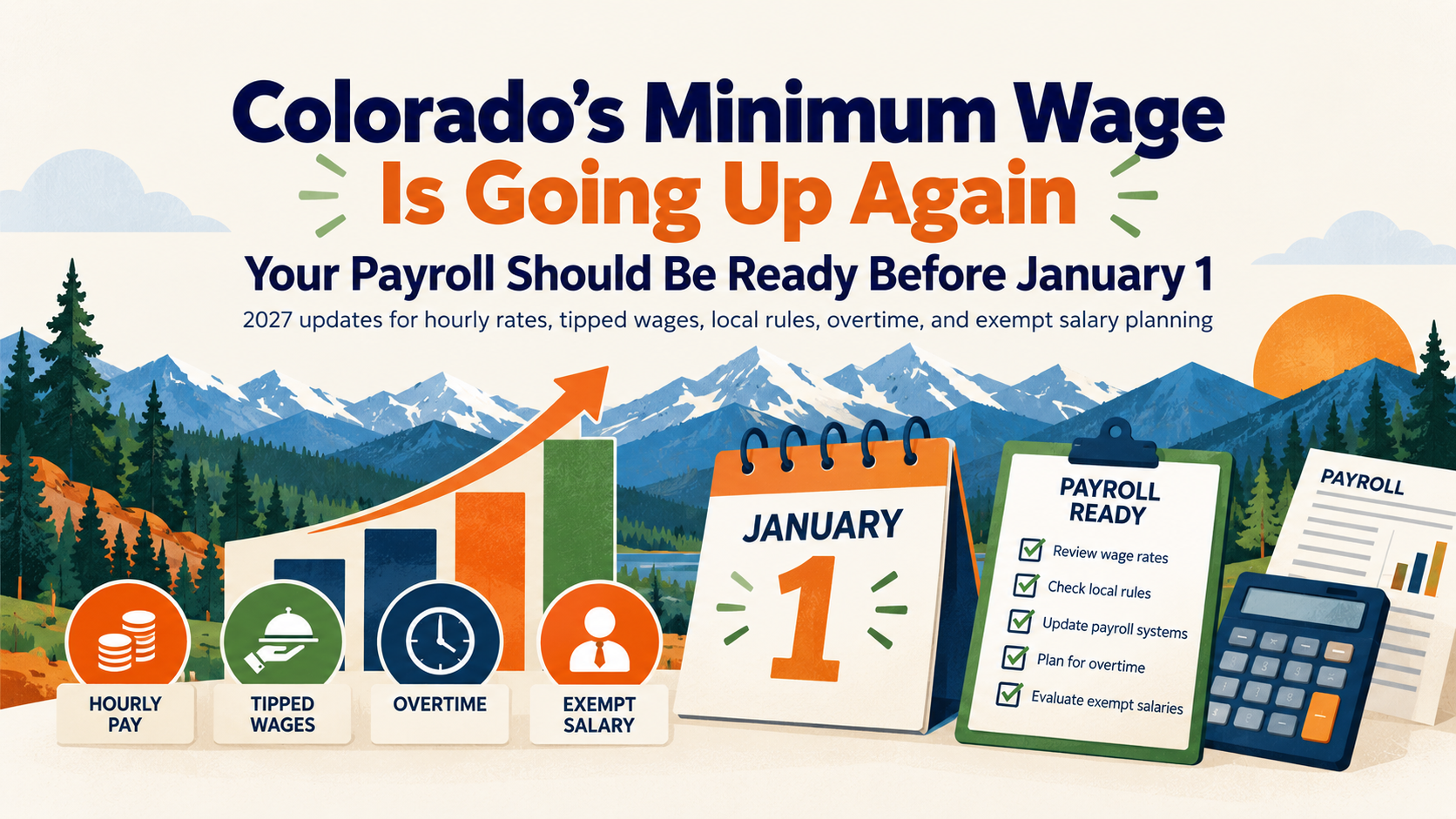
January 1 has a sneaky way of showing up in payroll.
One minute you are finishing Q3, planning holiday schedules, and wondering how it is already October.
The next minute someone is processing the first payroll of the new year and asking:
"Wait. Did the minimum wage change?"
Yes.
For Colorado employers, it did.
Colorado's statewide minimum wage will increase from $15.16 per hour in 2026 to $15.71 per hour beginning January 1, 2027. The minimum cash wage for qualifying tipped employees will increase from $12.14 to $12.69 per hour. The Colorado Department of Labor and Employment announced the new rates in August.
A 55-cent increase may not sound like a major payroll event.
For some employers, it is not.
For others, it affects hourly rates, overtime, tipped employees, wage compression, budgets, local wage requirements, payroll settings, and potentially exempt employee salaries.
So this is one of those changes worth handling before January 1 instead of during the first payroll after it.
Beginning January 1, 2027, Colorado's statewide minimum wage will be $15.71 per hour.
The 2026 rate is $15.16, so the increase is 55 cents per hour, or approximately 3.6 percent.
Colorado's minimum wage is adjusted annually based on inflation. The Colorado Constitution requires the rate to increase each year based on the applicable Consumer Price Index.
That means annual wage changes are not exactly a surprise anymore.
We know they are coming.
The number changes.
The process should not.
And that is where employers can make January much easier on themselves.
The statewide minimum cash wage for qualifying tipped employees will increase to $12.69 per hour beginning January 1, 2027.
Colorado allows employers to take a tip credit of no more than $3.02 per hour for employees who qualify under the tipped wage rules. That $3.02 amount is set in the Colorado Constitution.
The important part is that the tip credit does not eliminate the employer's responsibility to ensure the employee receives the full applicable minimum wage.
If an employee's wages plus qualifying tips do not reach the required minimum wage, the employer is responsible for making up the difference.
Restaurants, hospitality businesses, salons, and other employers with tipped workers should be especially careful when payroll rates change.
Your payroll system may know the new minimum wage.
That does not necessarily mean it knows whether every employee actually qualified for every tip credit you took.
No.
The statewide minimum wage is the floor for covered employees where a higher local wage does not apply.
Several Colorado communities have their own minimum wage requirements.
Denver, for example, has announced a 2027 minimum wage of $19.84 per hour, up from $19.29 in 2026. The City of Boulder has a scheduled 2027 minimum wage of $18.17 per hour.
That creates an important payroll question:
Where does your employee actually work?
Not where your company is headquartered.
Not where your payroll account is registered.
Where the work is performed.
Denver's wage rules, for example, generally apply to work performed within the City and County of Denver. Denver excludes employees who perform fewer than four hours of work in Denver during a week, as well as employees who are merely traveling through the city.
That can matter for businesses with field employees, salespeople, technicians, event staff, remote employees, or anyone who regularly works in more than one city.
Payroll used to be mostly about who worked and how many hours they worked.
Increasingly, it is also about where those hours happened.
You should still take a look at your compensation.
Imagine you currently have an entry-level employee earning $15.75 per hour.
That employee is technically above the 2026 minimum wage of $15.16.
On January 1, the new minimum wage becomes $15.71.
Congratulations.
Your 59-cent cushion just became 4 cents.
That may be legally compliant, but it may create a different business problem.
If newer employees, trainees, or less experienced employees suddenly move very close to the pay of more experienced team members, you may have wage compression.
Wage compression happens when the pay difference between employees with different levels of experience, responsibility, tenure, or skill becomes very small.
The minimum wage increase does not require you to give everyone in the company a raise.
But it is a good reason to look at the whole pay structure before making isolated changes.
If one employee moves up, what does that do to the person training them?
What happens to the shift lead?
What happens to the employee who has been there three years?
Sometimes the payroll change is 55 cents.
Sometimes the business impact goes several layers deeper.
It can.
Colorado generally requires covered nonexempt employees to receive overtime at one and one-half times their regular rate of pay after more than 40 hours in a workweek, more than 12 hours in a workday, or more than 12 consecutive hours, whichever calculation produces the greater amount of pay.
If an employee's regular hourly rate increases because of the new minimum wage, the employee's overtime rate increases too.
An employee earning $15.71 per hour would generally have a base time-and-one-half rate of $23.565 per hour before considering any other compensation that may need to be included in the employee's regular rate.
And there is the phrase that causes so many payroll headaches:
Regular rate.
An employee's overtime rate is not always calculated from their base hourly wage alone.
Certain nondiscretionary bonuses, commissions, shift differentials, and other compensation may need to be included when calculating the regular rate for overtime purposes.
So when you update wages, this is also a good time to look at how overtime is being calculated.
Do not just make sure the hourly rate changed.
Make sure the math downstream still works.
This is another area employers should have on their year-end payroll checklist.
Colorado's salary thresholds for certain exempt employees are indexed annually. Under the Colorado Overtime and Minimum Pay Standards rules, salary thresholds for executive, administrative, and professional exemptions are adjusted based on the same inflation measure used for the state minimum wage.
That means employers should not assume that an employee who qualified as salaried exempt in 2026 will automatically continue qualifying in 2027.
Salary is also only one part of the exemption.
The employee still has to satisfy the applicable duties requirements.
Someone does not become exempt simply because we put them on salary.
And someone does not remain exempt forever because they qualified when they were hired.
Before year-end, review employees who are classified as exempt and confirm the current Colorado salary and duties requirements before the first payroll of 2027.
This is especially important for employees sitting close to the minimum salary threshold.
Please do not make that your entire payroll compliance strategy.
A good payroll provider should update system tax tables and many statutory wage settings.
That does not mean your payroll provider knows your employees.
They do not necessarily know that Maria works in Denver every Thursday.
They may not know that Sam should receive a pay increase because his current rate will fall below the new minimum.
They do not know whether your assistant manager still meets the requirements for an overtime exemption.
They do not know that one employee's work location changed six months ago but nobody updated the payroll profile.
And they certainly do not know whether raising your entry-level wage creates a compensation problem for three other employees.
Payroll software processes the information you give it.
It cannot fix information it never received.
This does not need to become a giant project.
A focused payroll review this fall should cover seven things:
That is considerably easier to do in October or November than at 4:47 p.m. on payroll day.
Earlier than the paycheck where they discover it.
Colorado requires employers to provide employees with information about their rate of pay, and employers should make sure payroll records accurately reflect wage changes.
But even beyond the documentation requirement, good communication matters.
If someone's hourly rate is changing, tell them.
If a larger compensation adjustment is being made because of wage compression, explain it.
If nothing is changing because the employee already earns comfortably above the new minimum, there may be nothing to announce.
What we want to avoid is having employees learn about compensation changes by studying their pay stub and trying to reverse-engineer what happened.
Payroll should not feel like a mystery novel.
If you are cleaning up payroll before year-end, this is also a good time to make sure your records are in order.
The IRS requires employers to retain employment tax records for at least four years after the tax becomes due or is paid, whichever is later. Those records include wage payments, employee identifying information, tax deposits, withholding forms, and other payroll documentation.
Colorado and local wage laws can have their own recordkeeping requirements as well.
Denver, for example, requires employers covered by its minimum wage ordinance to maintain payroll records for three years.
Good payroll records are not just useful when an agency asks for them.
They help you answer basic business questions.
When did this employee's rate change?
Why did it change?
Where was the employee working?
How was overtime calculated?
What did we communicate?
If answering those questions requires five people, three email inboxes, and someone's memory from 2024, your payroll records probably need a little love.
Legally, January 1 is when the new wage takes effect.
Operationally, your deadline should be earlier.
You need enough time to review pay rates, make compensation decisions, communicate changes, update payroll, test calculations, and correct anything that does not look right.
You also need to pay attention to which workweek crosses January 1.
If a payroll period starts in December and ends in January, the applicable wage rate depends on when the work was performed.
Do not assume that because payday occurs in January, one rate automatically applies to every hour in that check.
Your payroll system needs to handle the effective date correctly.
This is exactly the sort of boring little detail that prevents very un-boring payroll corrections later.
Colorado's statewide minimum wage will be $15.71 per hour beginning January 1, 2027. The 2026 minimum wage is $15.16 per hour.
The statewide minimum cash wage for qualifying tipped employees will be $12.69 per hour. Colorado generally allows a tip credit of up to $3.02 per hour when the applicable requirements are met.
Denver's minimum wage will increase to $19.84 per hour on January 1, 2027. Denver's 2026 rate is $19.29 per hour.
The City of Boulder's scheduled minimum wage is $18.17 per hour beginning January 1, 2027.
Not always. Local minimum wage requirements can depend on where the employee performs the work. Employers with remote, traveling, field, or multi-location employees should review the rules for each applicable jurisdiction.
No. Employees already earning more than the applicable minimum wage do not automatically have to receive a raise because the minimum changes. Employers may still want to review wage compression and overall pay relationships before changing lower-paid employees' rates.
Colorado's salary threshold for certain overtime exemptions is indexed annually. Employers should confirm the final 2027 threshold and review employees near that amount before the new year. Meeting the salary threshold alone does not make an employee exempt. The applicable duties requirements must also be satisfied.
Some statutory settings may update automatically, but employers remain responsible for employee pay rates, classifications, work locations, tip information, and other payroll data. Do not assume your system knows an employee's rate should change unless someone has actually told it.
That may be the nicest thing we can say about payroll.
Boring is good.
Boring means everyone was paid correctly.
The wage rates were right.
The overtime calculation worked.
The employee did not call because their paycheck looked weird.
Nobody is trying to figure out whether an adjustment needs to be made retroactively.
And nobody started the year with a wage claim because a 55-cent increase was missed.
Colorado's 2027 minimum wage change is not complicated.
The statewide rate becomes $15.71.
The harder part is everything connected to that number.
Tipped wages.
Local minimum wages.
Overtime.
Exempt salaries.
Work locations.
Compensation relationships.
Payroll configuration.
Those are the things worth looking at now.
A little payroll cleanup in the fall is a whole lot easier than fixing the first three paychecks of the new year.
And if January 1 arrives and your payroll feels completely uneventful?
Perfect.
That means somebody did their job.




.svg)