

Location
123 Business Street, Suite 456
New York, NY 10001, USA
Contact us
Location


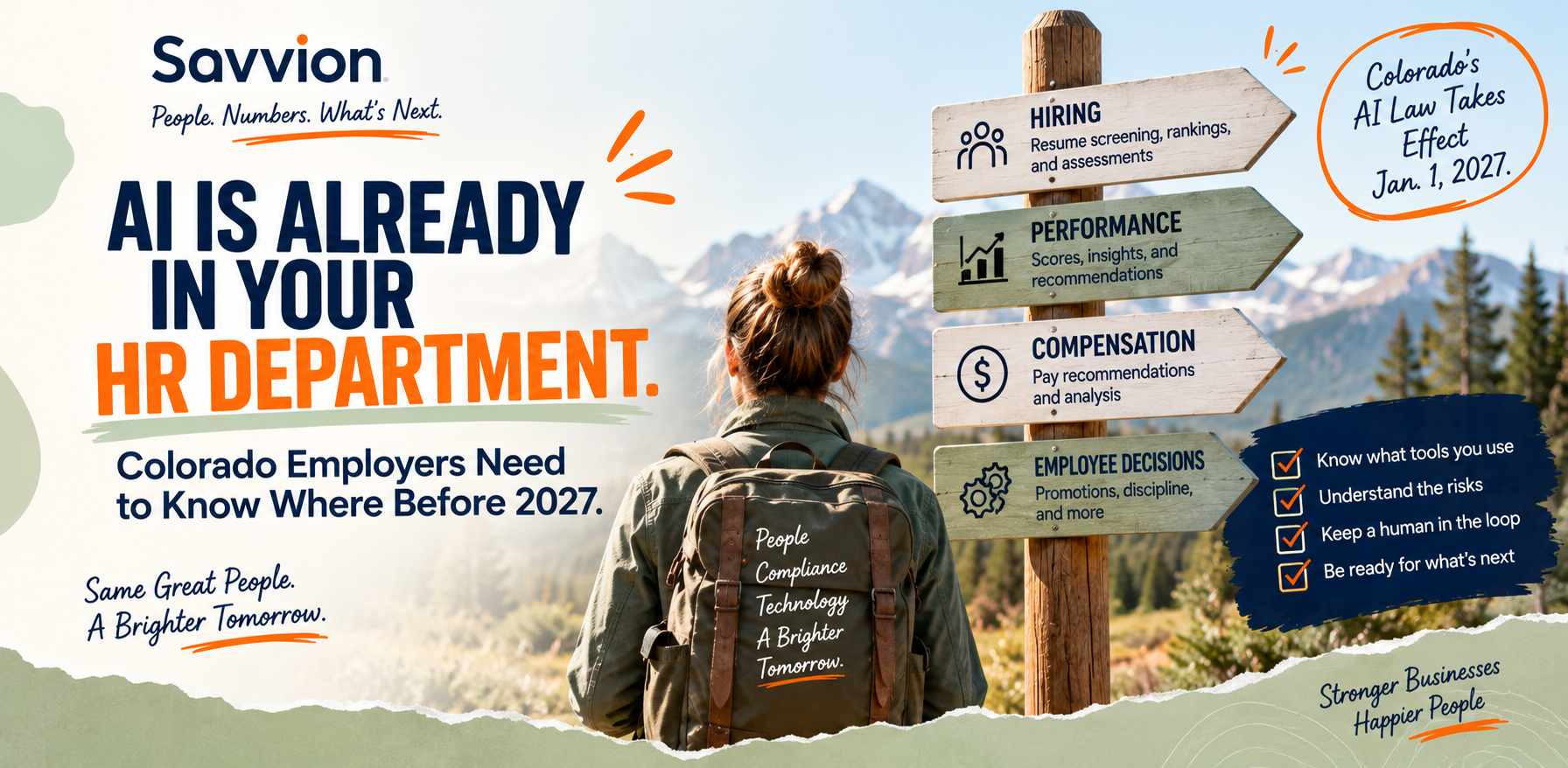
You may not think your company uses artificial intelligence to make employment decisions.
Fair enough.
You are probably not sitting in a conference room asking a robot which employee gets promoted.
But your applicant tracking system might rank candidates.
Your recruiting platform might recommend applicants.
An assessment tool might score someone's likelihood of success.
Your HR software might identify employees for compensation adjustments.
A performance platform might generate rankings, predictions, or recommendations.
And suddenly the question is not, “Does our business use AI?”
It is, “Where is AI influencing decisions about our people?”
That is a question Colorado employers should start answering now.
Beginning January 1, 2027, Colorado's Automated Decision-Making Technology Act will regulate certain technology used to materially influence consequential decisions, including decisions related to employment. The law was passed as Senate Bill 26-189 in May and replaced an earlier version of Colorado's AI legislation with a new framework focused heavily on transparency, information, and meaningful human review.
You do not need to become an artificial intelligence expert before January.
You probably do need to know what is inside your HR technology.
Quite a bit.
Colorado's law defines automated decision-making technology, or ADMT, as technology that processes personal information and uses computation to generate things like predictions, recommendations, rankings, classifications, or scores that are used to make, guide, or assist a decision about an individual.
A consequential decision includes decisions involving employment. That means employers should think beyond software that actually makes the final decision. The phrase that matters is “materially influence.”
If a technology meaningfully affects how an applicant or employee is evaluated, ranked, selected, compensated, or otherwise treated, it may deserve a closer look. That could potentially include recruiting technology, candidate screening tools, automated assessments, employee scoring systems, compensation tools, or performance platforms. The important question is not whether the software company puts “AI powered” across its homepage. The important question is what the technology actually does.
Not every use of AI in the workplace is suddenly an automated employment decision.
Using an AI tool to help draft a job description, summarize meeting notes, brainstorm interview questions, or organize information is very different from allowing a system to rank candidates or meaningfully influence who gets hired.
The law focuses on technology that materially influences consequential decisions.
That distinction is important because businesses are already using artificial intelligence for dozens of administrative tasks.
The goal should not be to panic every time someone opens an AI tool.
It should be to understand when the technology moves from helping someone do their work to influencing an employment decision about another person.
There is a big difference between:
“Help me clean up this job description.”
and
“Rank these 47 applicants and tell me which five I should interview.”
That second use deserves more attention.
This is the part we think employers should take seriously. Most small businesses are not intentionally building AI-driven employment systems.
They are buying software. And modern software vendors are adding AI features quickly. An applicant tracking system you purchased three years ago may now automatically rank resumes. A recruiting site may recommend which applicants appear first. A video interviewing system may score responses. A performance tool may identify “high potential” employees. A workforce analytics system may flag someone as a retention risk. A compensation platform may recommend raises.
The employer may never have made a conscious decision to adopt an AI employment tool. The feature simply appeared in software the company was already using. That does not make the underlying employment decision less important.
Colorado's law creates transparency requirements when covered automated decision-making technology is used.
The enacted law requires deployers of covered technology to provide clear and conspicuous notice at the point where a person interacts with covered ADMT.
If the technology contributes to an adverse consequential decision, the person must generally receive a plain-language description of the technology's role within 30 days. The law also creates rights involving access to certain personal data, correction of inaccurate information, and meaningful human review and reconsideration after an adverse outcome.
Think about what that means in an employment setting.
If technology materially contributes to rejecting a candidate, denying a promotion, or making another negative employment decision, “the computer said no” is not exactly where Colorado wants the process to end.
Human beings still need to understand the decision-making process.
And the person affected by the decision may have rights to understand and challenge the information involved.
Because algorithms can be confidently wrong. So can humans, of course. But automated systems create a different problem because they can repeat the same mistake very efficiently. Maybe a resume screening system undervalues an unconventional career path. Maybe an assessment disadvantages someone with a disability. Maybe incorrect employee information gets pulled into a performance recommendation. Maybe a system was trained for one type of job and someone decides to use it for another.
The Colorado law specifically includes meaningful human review and reconsideration among the protections available following certain adverse decisions. That is a useful HR principle even before the law takes effect. Technology can help organize information. It can highlight patterns. It can make recommendations. But somebody inside the organization should still understand why an employment decision is being made and be willing to own it.
If your manager's explanation for why someone was rejected is, “That is what the system gave me,” your process probably needs work.
No.
This is where the conversation gets bigger than one new statute. Existing employment discrimination laws do not disappear because an algorithm was involved.
The Equal Employment Opportunity Commission has specifically warned that employers' use of artificial intelligence and software tools in hiring and employment decisions can create discrimination concerns under federal law. The EEOC has highlighted risks involving automated resume screening, assessments, performance monitoring, promotion decisions, and other employment tools.
Disability discrimination is one example.
A screening or assessment tool could unintentionally screen out a qualified applicant because of a disability rather than because the person cannot perform the job. Employers may also need a process for providing reasonable accommodations when automated assessments are used. The important takeaway is that outsourcing part of a hiring process to software does not outsource the employer's responsibility for the outcome. Your vendor built the tool. Your business still made the employment decision.
Small businesses should not assume that “we are too small for this” automatically ends the analysis.
The enacted Colorado law broadly addresses developers and deployers doing business in Colorado that use covered automated decision-making technology. It also contains specific exemptions for certain entities and activities, so whether a particular business or tool is covered depends on the circumstances. The official legislative summary does not frame the law as something limited only to large employers.
For a small employer, this does not mean creating a 40-page AI governance program tomorrow. It means knowing enough about your systems to recognize whether one of them is materially influencing employment decisions. That is a much more manageable place to start.
There is another reason we would not recommend downloading a random “Colorado AI compliance checklist” today and assuming the job is finished.
The Attorney General is still completing the rulemaking process. The Colorado Attorney General filed proposed ADMT rules on August 11, 2026. Public comments remain open through October 26, and an updated proposed draft is expected by September 23. The law itself takes effect January 1, 2027.
So right now is the inventory stage.
Figure out what you have.
Figure out what it does.
Figure out who is using it.
Figure out whether it influences decisions about employees or applicants.
Once the final rules are available, businesses can refine the compliance pieces.
Trying to build the perfect policy before you know what technology you are actually using is backwards.
You do not need to ban AI or shut down your recruiting systems.
You do need to understand them.
A practical fall review might look like this:
None of that requires a computer science degree. Mostly, it requires asking better questions.
Do not settle for, “Yes, our platform uses AI responsibly.”
That sentence tells you almost nothing.
Ask what the system evaluates.
Ask whether it ranks or scores individuals.
Ask what information is used.
Ask how recommendations are generated.
Ask whether your team can override a recommendation.
Ask what happens when an applicant or employee challenges inaccurate information.
Ask what documentation the vendor will provide for Colorado employers before January 1, 2027.
The new Colorado law requires developers of covered ADMT to provide deployers with information about intended uses, categories of training data, known limitations, and instructions for appropriate use and human review. Developers are also required to notify deployers of material updates or modifications.
That gives employers a pretty good starting point for their vendor conversations. If your vendor cannot explain how its product influences employment decisions, that itself is useful information.
This is where a basic internal AI policy becomes useful. You do not necessarily need a giant policy filled with technical jargon.
You do need some boundaries. For example, managers should understand whether they can upload resumes into public AI systems, whether confidential employee information can be entered into outside tools, whether AI can be used to evaluate performance, and whether an AI-generated recommendation can ever substitute for manager judgment.
Privacy belongs in this conversation too. Employee records contain a lot of information you probably do not want copied into whichever AI tool someone happens to have open in another browser tab.
A good AI policy should answer both questions:
What are we allowed to put into these systems?
And what are we allowed to let these systems decide?
Colorado's Automated Decision-Making Technology Act takes effect January 1, 2027. The law was enacted through Senate Bill 26-189 in May 2026.
Yes. Employment is specifically included among the consequential decision areas covered by the law. The law applies when covered automated decision-making technology materially influences a consequential decision.
No. The focus is on automated decision-making technology that materially influences consequential decisions. Using AI simply to draft, organize, or summarize information is different from using a system to score, rank, recommend, or otherwise meaningfully influence an employment decision.
Your vendor may have important obligations as the developer of the technology, but employers using covered systems can have responsibilities of their own as deployers. The law creates obligations for both developers and deployers.
Yes. Federal employment discrimination laws continue to apply to employment decisions involving automated systems. The EEOC has specifically addressed discrimination risks associated with AI and algorithmic employment tools.
Not yet. As of September 21, 2026, the Attorney General's formal rulemaking process is still underway. Proposed rules were filed August 11, public comments remain open through October 26, and an updated proposal is expected by September 23.
There are some genuinely useful AI tools coming into the workplace. They can save time. They can help organize information. They can make recruiting faster. They can help small businesses that do not have giant HR departments work more efficiently. That is a good thing. But speed is not the same thing as judgment.
If software recommends that you reject an applicant, deny a promotion, change someone's compensation, or flag an employee as a performance problem, somebody inside the business still needs to understand what happened.
That is where Colorado's new law is headed. More transparency. More ability to question the information behind automated decisions. More meaningful human involvement when technology affects someone's employment. For small businesses, the best preparation right now is surprisingly simple.
Go find the AI. Not someday. Not when your software company sends you a compliance email on December 29. Now.
Figure out which systems are helping your people make decisions and which systems are starting to make decisions for them.
That distinction is about to matter a lot more.
And, frankly, it is a pretty healthy HR question whether the law required it or not.




.svg)